
Olive Groves in Puglia: How to Experience Them Properly
There is a particular stillness in the Puglia countryside that is difficult to describe unless you’ve experienced it yourself. It is something you begin to notice when you look at the olive trees: monumental, rooted yet constantly reshaped by time.
These trees are millennia old, irregular, sculptural, and almost human in their posture. Many are twisted into forms that seem impossible to sustain life.
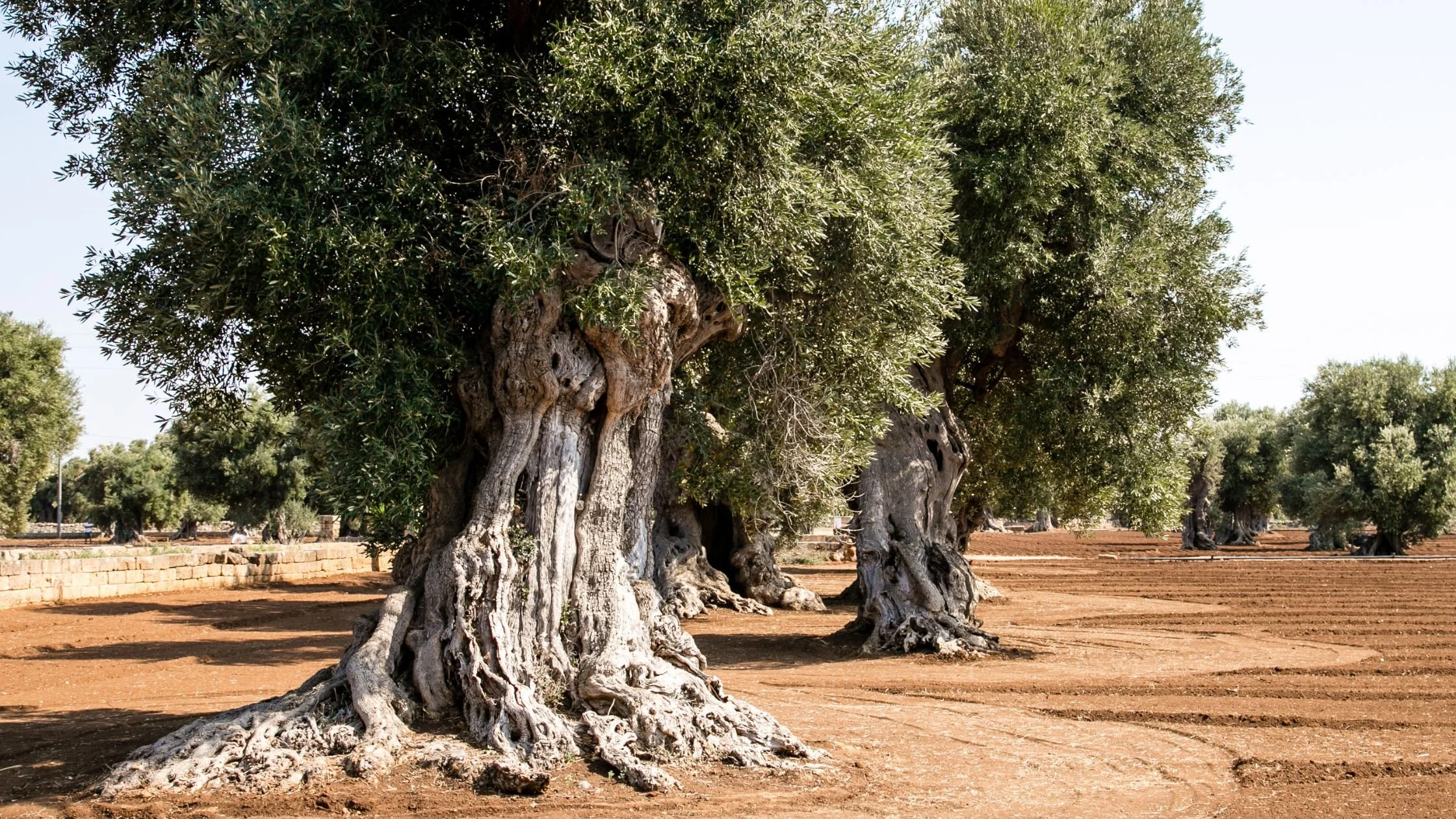
I have yet to meet a traveller that wasn’t, in some way, moved by them and this is why I always recommend visiting olive groves when coming to Puglia. Not as an optional stop, but as something essential to understanding the region.
This is something I always prioritise when designing my clients’ itineraries, when they tell me they want to go beyond the surface of Puglia, or when food and local traditions are an important part of their journey.
If you’re planning to visit an olive grove in Puglia, there are a few things I always suggest, small details that make the difference between a pleasant visit and a memorable one:
Visit a grove with century or millennia-old olive trees
When possible, visit with the owner or producer
Look for one that includes a frantoio ipogeo (underground mill)
Opt for a blind olive oil tasting
Visit a grove with century or millennia-old olive trees
Some groves still hold these ancient trees, while others have younger ones, especially in areas affected by a bacteria that has reshaped parts of the landscape in recent years. Supporting both matters, but if you want to witness what nature, time, and care can create together, ancient trees are something else entirely.
Their trunks carry the marks of time, lines that resemble deep wrinkles on a face that has lived, while their shape reveals how something so rooted can also be deeply dynamic.
Something most visitors don’t realise is that within the same grove, not every millennia-old tree necessarily belongs to the landowner.
Some of these ancient trees are protected under regional law, recognised as part of Puglia’s cultural heritage. The owner cares for them, harvests them, even produces oil, but they are not simply agricultural assets. They are, in many ways, historical entities.
visit with the owner or producer
Having the opportunity to visit an olive grove with the owner is definitely a plus. You’re not just walking through land, you’re hearing about generations, about techniques, about seasons that were generous, and others that were not. And, increasingly, about the challenge of Xylella and what it has meant, not just economically, but emotionally, for those who have grown up with these trees.
Personal Note: I recently had a client message me straight after visiting an olive grove. The farmer had opened up about the challenges of Xylella, how they worried for their trees and their commitment to protect them, and she told me it was one of the most emotional moments of her trip. Something she knows she won’t forget.
Look for one that includes a frantoio ipogeo (underground mill)
Then, if you want to take the experience a step further, look for a grove that includes a frantoio ipogeo (hypogeum mill). This is one of those experiences in Puglia that most travellers don’t expect.
The entrance is often small and once inside the temperature drops, the light softens, and the space opens into something unexpected.
These mills once formed the centre of olive oil production, with entire communities living and working underground throughout the harvest season.
The choice to carve these spaces into the rock was due to two factors, temperature and safety.
The rock, calcarenite, naturally maintains a constant temperature of around 20°C, ideal for separating oil from water. At the same time, being underground offered protection. From heat, from oxidation, and historically, from foreign raids.
Standing in one of these spaces today, it’s hard not to feel a sense of respect for the work that took place here. Olive oil, in this context, is no longer just an ingredient. It’s the result of knowledge, adaptation, and endurance.
Opt for a blind olive oil tasting
And then, at the end of it all, comes the tasting. If you have the option, choose a blind tasting.
It’s more engaging, more honest, and more fun. Without labels or expectations, you start to notice differences you might otherwise miss. Bitterness, spice, freshness. You begin to understand olive oil not just as something you like, but something you can recognise.
For me, a slice of good bread, toasted, with olive oil, salt, and oregano is enough to feel at home anywhere.
But in Puglia, it’s something more.
If you’re planning a trip to Puglia and want to experience this properly, this is something I can help you include in your itinerary.
How can we help?
If you would like to leverage our local insights to plan your holiday, we’d be delighted to assist you in designing the perfect trip. Whether you're seeking an authentic local experience or simply want to immerse yourself in the vibrant culture of Puglia, we can tailor a personalised itinerary to ensure you make the most of your time in the region.
Let us help you create a truly unforgettable holiday.